Is Curiosity Working Again on Mars
9 years on Mars! Curiosity rover marks some other anniversary
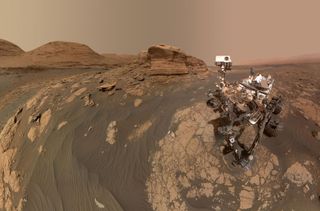
NASA'southward Curiosity rover has now been exploring Mars for 9 years.
The car-sized robot launched in November 2011 and touched down inside Mars' 96-mile-wide (154 kilometers) Gale Crater on the dark of Aug. 5, 2012. (The landing occurred on Aug. six Eastern time, but information technology was all the same Aug. 5 in California, where NASA's Jet Propulsion Laboratory, which manages Curiosity'southward mission, is based.)
Ever since, Curiosity has been helping scientists amend empathize Mars' past habitability and how the planet has inverse over time. For example, the rover's observations have shown that Gale hosted a lake-and-stream organisation in the ancient by, which may have been capable of supporting Earth-like life for millions of years at a time.
Related: Amazing Mars photos by NASA'southward Curiosity rover
In September 2014, Marvel reached the base of Mountain Abrupt, which rises 3.4 miles (5.5 km) into the Cerise Planet's heaven from Gale's center. The vi-wheeled robot so began picking its way upwards the broad, sloping massif, reading the rock layers as it climbed.
Embedded in those layers is a history of Mars' climate, which shifted over the eons from relatively warm and wet to cold and os-dry. And Curiosity is now poised to gather data that could shed considerable lite on this shift.
The rover has near reached a section of Mount Sharp rich in sulfate-begetting rocks, which are indicative of a relatively dry surroundings. The layers Curiosity has examined on the slopes thus far accept generally harbored clays, which grade in the presence of liquid h2o.
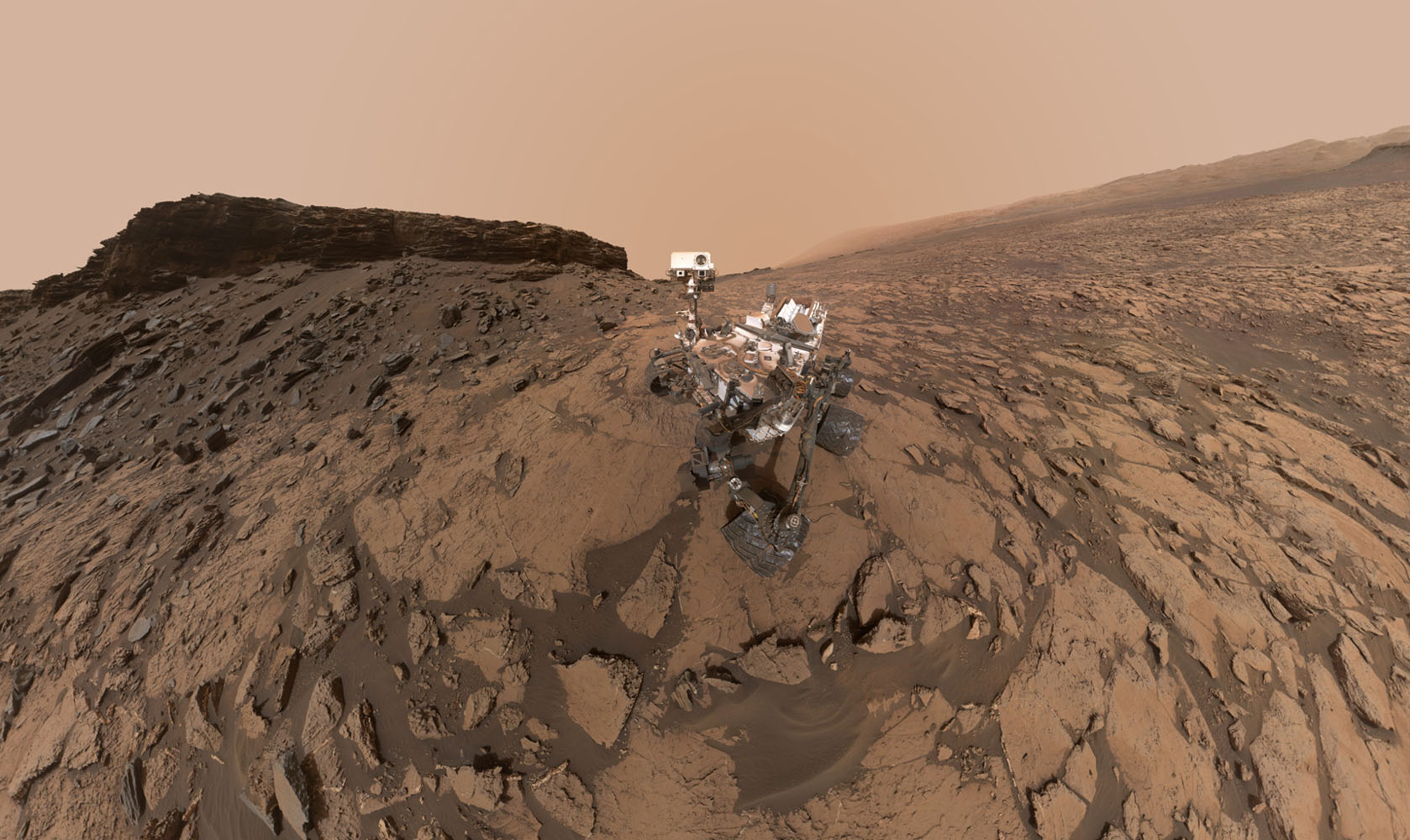
Curiosity has made a number of other intriguing finds during its fourth dimension on Mars. For example, it has discovered organic chemicals, the carbon-containing building blocks of life equally nosotros know information technology. And the rover has detected several spikes in the concentration of methane, which here on World is generated primarily by living creatures.
Methane can also be produced by abiotic processes, however, and the source of the gas in Gale Crater remains a mystery.
During its nine years on Mars, Curiosity has traveled a total of sixteen.14 miles (25.98 km). And its odometer could keep ticking over for a while to come up. The rover is in good health despite its relatively avant-garde age, mission team members have said, and its nuclear ability system is designed to operate for a minimum of 14 years. (All give-and-take of years in this story refers to Globe years. Mars years are longer, each one lasting well-nigh 687 Earth days.)
Curiosity isn't the simply robot active on the Martian surface. NASA'due south InSight lander has been listening for Marsquakes since its November 2018 touchdown, and the agency's Perseverance rover landed this past February inside the 28-mile-wide (45 km) Jezero Crater.
Perseverance, which is modeled heavily on Marvel, is hunting for signs of ancient Mars life and collecting samples for future return to World. Perseverance traveled to Mars with the iv-pound (ane.eight kilograms) Ingenuity helicopter, which has made 10 flights (and counting) within Jezero.
Then in that location'south the Zhurong rover, which is function of Tianwen-1, China's first fully homegrown Mars mission. Zhurong landed on May 14, kicking off a surface mission designed to last at to the lowest degree iii months.
Mike Wall is the writer of " Out There " (Grand Central Publishing, 2018; illustrated by Karl Tate), a volume about the search for conflicting life. Follow him on Twitter @michaeldwall. Follow the states on Twitter @Spacedotcom or Facebook.
Join our Space Forums to continue talking space on the latest missions, night sky and more! And if you have a news tip, correction or annotate, let us know at: community@space.com.

Michael Wall is a Senior Infinite Writer with Infinite.com and joined the team in 2010. He primarily covers exoplanets, spaceflight and military space, merely has been known to dabble in the space art beat. His book about the search for alien life, "Out There," was published on November. 13, 2018. Before becoming a science writer, Michael worked as a herpetologist and wildlife biologist. He has a Ph.D. in evolutionary biological science from the Academy of Sydney, Australia, a bachelor's degree from the University of Arizona, and a graduate certificate in scientific discipline writing from the University of California, Santa Cruz. To observe out what his latest project is, you can follow Michael on Twitter.
castlemanwittentiou.blogspot.com
Source: https://www.space.com/curiosity-rover-nine-years-on-mars
0 Response to "Is Curiosity Working Again on Mars"
Post a Comment